Visitors to Italy are always struck by how beauty is spread across the whole country: it is not only the great monuments, but the fact that any small village can hold a square, an old church and a view that tell of a past you do not just visit, but can step right into. Another thing everyone envies us is food, and the way we live it: not only the quality, but a set of unwritten yet unbreakable rituals, like the lunch you never skip and the long dinners. And what surprises people most is how varied the country is inside: Milan, Naples and Sardinia, for instance, seem almost to belong to different countries, each with its own dialects, cooking and outlook. Speaking of cooking, we want to take a journey through history, from north to south, into the world of Italian fresh pasta.
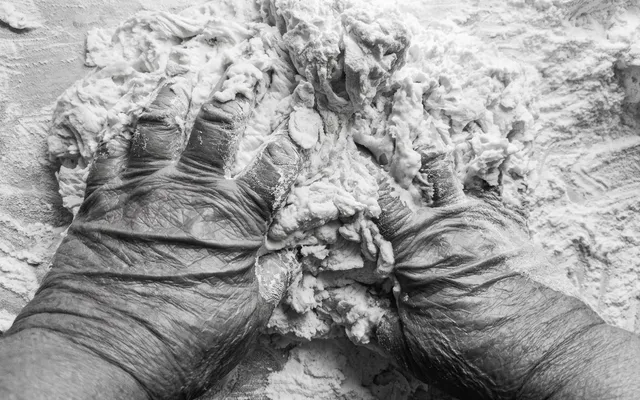
Before it reached restaurant plates, fresh pasta was born on family tables, kneaded by hand on the wooden board, with whatever there was. That is why Italy does not have one fresh pasta, but many, and each tells the story of the place it comes from.
The roots are ancient. The Romans already knew lagana, a sheet cut into strips that many consider an ancestor of lasagne. But it was in the Middle Ages and the Renaissance that pasta began to take the shapes we recognise today, and to split into two great traditions.
The border between those two traditions is the raw material. In the North, where soft wheat is mostly grown, pasta is made with eggs. In the South, durum wheat country, semolina and water are enough. Dried pasta, the kind that keeps for a long time, found its best-known centres in the South, between Naples and Gragnano, where the climate helped it dry. Fresh pasta, on the other hand, long remained a home affair: it was made at home, for the same day, and often only for special occasions.
Understanding these differences helps to read the map that follows. It is not a list of recipes, but a journey through landscapes, crafts and habits, in which every pasta shape has a precise reason for being that shape and no other.
The North: egg pasta
In the North, where soft wheat grows well on the plains, pasta is made with flour and eggs. In Emilia-Romagna it is an art: the sfoglina rolls the sheet with a rolling pin until it is as thin as a veil, and from it come tagliatelle, tortellini and cappelletti. Legends live around these pastas, like the one that credits the first tagliatella to a cook inspired by Lucrezia Borgia’s hair: more a tale than documented history, but it shows how much Bologna cares about it.
The heart of Emilia is the sfoglia. The Bolognese dough is made of eggs and flour alone, in the traditional proportion of one egg per 100 grams of flour, with no water or oil. It is worked on a big wooden board and rolled with a long rolling pin, which can reach a metre, until the sheet is thin and almost transparent. Rolled up and cut with a knife it gives tagliatelle; with spinach in the dough, the green lasagne of Bologna.
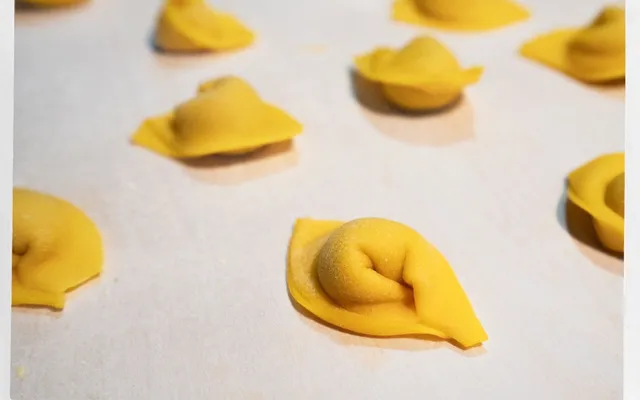
Bologna has an almost notarial relationship with its pasta. In 1972 the Accademia Italiana della Cucina deposited the official width of the tagliatella with the city’s Chamber of Commerce: eight millimetres once cooked. As for tortellini, the story goes that their shape copies the navel of Venus, spied on by a curious innkeeper: a legend once again, but one of those that come with the dish at Christmas, when it is served in broth. Emilia also has a whole family of filled pastas, from the anolini of Parma to the cappellacci of Ferrara, which add a filling to the sheet.
Between Bologna and Modena the dispute over tortellini is as old as it is affectionate. There is a trace of it in a seventeenth-century poem, La secchia rapita by the Modenese Alessandro Tassoni, and in 1974 the Bolognese Confraternita del Tortellino deposited the official recipe. The legend of Venus’s navel is set in Castelfranco Emilia, today in the province of Modena but once Bolognese territory: a story that seems made on purpose to keep everyone happy.
The sfoglia goes with ragù, and here too Bologna has set the rules: in 1982 the same Accademia deposited the classic recipe, made with minced meat, pancetta, soffritto, a little tomato, wine and milk. It is served with tagliatelle, while in lasagne it alternates with layers of béchamel.
Moving into Romagna the register changes. Pellegrino Artusi, from Forlimpopoli, gives plenty of space to cappelletti in his La scienza in cucina e l’arte di mangiar bene of 1891, and in Romagna homes they are still the Christmas dish. Here you also find strozzapreti, rustic hand-rolled twists of pasta whose name, according to popular tradition, recalls how greedily the priests devoured them, and garganelli, made by rolling a square of pasta on a wooden comb to give it its typical ridges. Garganelli are said to come from Imola and an improvised birth in the eighteenth century, with a cook who ran short of filling for cappelletti: a story Romagnoli are happy to tell without worrying too much about the evidence. Our own story, that of the Romagna sfoglia, is on the story page.
In Piedmont, next to tajarin, there are agnolotti del plin, filled with meat and closed with a pinch (plin, in dialect) of the fingers. In Lombardy, around Bergamo and Brescia, casoncelli bring together meat, breadcrumbs and often a touch of sweetness, while around Mantua people eat pumpkin tortelli, where pumpkin meets mostarda. In Friuli, in the mountains of Carnia, cjarsons are filled pasta mixing sweet and savoury, with herbs, ricotta, spices and sometimes raisins: a border pasta that recalls the exchanges with the world of Central Europe.
The Centre: between egg and water
Further south, the two traditions meet. In Tuscany the pici of Siena, long and irregular, are made by hand with flour and water, alongside pappardelle with wild boar ragù. The Marche have the very fine maccheroncini of Campofilone and vincisgrassi. Umbria has strangozzi, Lazio fettuccine and tonnarelli, and Abruzzo spaghetti alla chitarra, cut on a frame of steel strings.
Pici have a country story: made without eggs, with flour and water only, they are rolled one by one under the palm of the hand, which is why no two pici are the same. Around Montepulciano they are called pinci. The most traditional sauce is simple: garlic, tomato, perhaps toasted breadcrumbs, the so-called mollica.
In the Marche, the maccheroncini of Campofilone are a case apart: a very thin egg pasta, almost a hair, which today has PGI status. Vincisgrassi, the lasagne of the Marche, have a story all their own: according to a popular tradition the name comes from the Austrian general Windisch-Graetz, stationed in Ancona at the end of the eighteenth century. But a recipe of the kind already appears in a cookbook from Macerata in 1779, so the legend should be taken with caution.
In Lazio, tonnarelli are in fact the Roman cousins of the chitarra: the same square section, and a destiny tied to dishes like cacio e pepe. It shows how pasta travels: the same cut, two regions, two names, two ways of dressing it. And Abruzzo, with its chitarra, is one of the few places where the tool itself gives the pasta its name.
The South: the strength of semolina
In the South durum wheat rules, and pasta is made with semolina and water, without eggs. It is a more rustic pasta, shaped with the fingers. In Puglia there are the orecchiette of old Bari, in Basilicata strascinati, in Calabria fileja wrapped around an iron rod, in Molise cavatelli. Sicily has the busiate of Trapani, twisted into a spiral, and Sardinia malloreddus and culurgiones, filled and closed with an ear-of-wheat pleat.
Orecchiette have a precise geography: in old Bari, in the narrow streets of the historic centre, women still make them by hand outside their front doors, cutting a cylinder of dough and pressing each piece with the tip of a knife to give it the shape of a little ear. They go with turnip tops, one of the great classics of Puglia. In Calabria fileja are wrapped around a thin iron rod that leaves a small hole in the middle, and are served with pork sauce or with ’nduja.
Sicily has one of the oldest stories. The Arab geographer al-Idrisi, describing the area of Trabia near Palermo in 1154, wrote of pasta being produced in the form of strands: one of the earliest written records of pasta in Italy, and a reminder of how much the South absorbed from the Mediterranean. Busiate, in their spirals, go with pesto trapanese, made with tomato and almonds. In Sardinia malloreddus, small ridged dumplings, are made with semolina and a touch of saffron, and eaten with sausage sauce and pecorino.
Around Italy, region by region
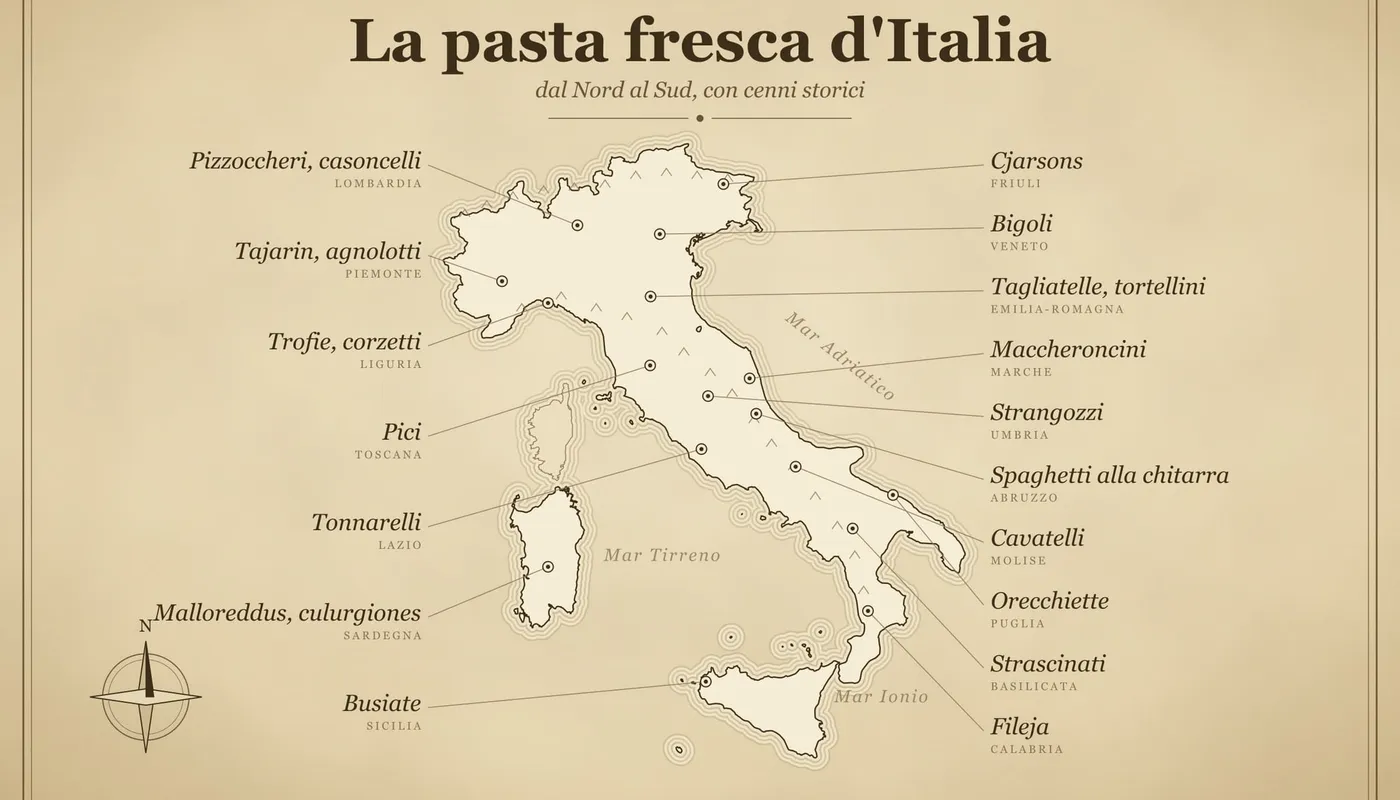
Every region has its own fresh pasta, from the egg pasta of the North to the semolina of the South. Here are the ones on the map at the top.
| Region | Fresh pasta | |
|---|---|---|
| North: egg pasta | Piedmont | tajarin, agnolotti |
| Lombardy | pizzoccheri, casoncelli | |
| Liguria | trofie, corzetti | |
| Veneto | bigoli | |
| Friuli | cjarsons | |
| Emilia-Romagna | tagliatelle, tortellini | |
| Centre: between egg and water | Tuscany | pici |
| Marche | maccheroncini | |
| Umbria | strangozzi | |
| Lazio | tonnarelli | |
| Abruzzo | spaghetti alla chitarra | |
| South and islands: semolina | Molise | cavatelli |
| Puglia | orecchiette | |
| Basilicata | strascinati | |
| Calabria | fileja | |
| Sicily | busiate | |
| Sardinia | malloreddus, culurgiones |
A geography on the plate
The split between egg pasta in the North and water pasta in the South is a simplification, because there are exceptions everywhere. But it tells a truth: every pasta shape is born of a grain, a climate, a way of life. And that is why fresh pasta remains one of the most beautiful things to tell: every strand, every sheet, every filling carries a piece of Italy with it.
Frequently asked questions
What is the difference between fresh pasta in the North and in the South?
The raw material. In the North, where soft wheat is mostly grown, pasta is made with flour and eggs; in the South, durum wheat country, semolina and water are enough. In the Centre the two traditions meet. It is a simplification, with exceptions everywhere, but it explains why each pasta shape is what it is.
What is one of the earliest written records of pasta in Italy?
In 1154 the Arab geographer al-Idrisi, describing the area of Trabia near Palermo, wrote of pasta being produced in the form of strands. It is one of the earliest written records of pasta in Italy.
How wide should a tagliatella be?
According to the measure deposited in 1972 by the Accademia Italiana della Cucina with the Chamber of Commerce of Bologna, eight millimetres once cooked.