Cappellacci · Filled pasta
Pumpkin cappellacci with speck and walnuts: an autumn recipe
In autumn it is pumpkin time straight away
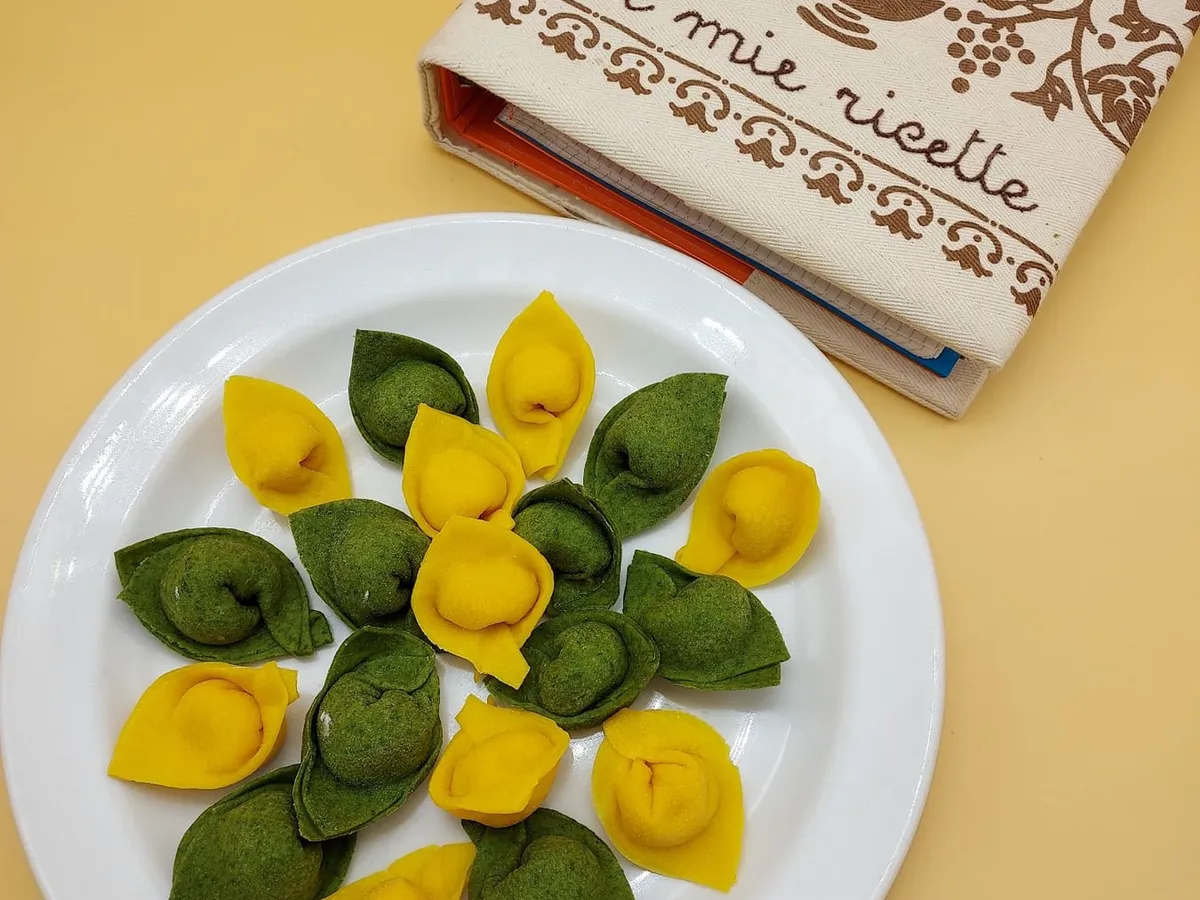
The story of pumpkin cappellacci begins after 1492: the pumpkin we know today came from the Americas, and in the sixteenth century it reached the kitchens of the Italian courts. At the Este court in Ferrara, sweet and savoury flavours together were especially loved, and pumpkins lent themselves to those pairings. The recipe is certainly from Ferrara, but pumpkin cappellacci soon became an iconic dish in Romagna too.
Cappellacci, not tortelli
The name can be confusing, but the difference is clear. Cappellacci are shaped like a hat, while Mantuan tortelli are square or rectangular. The biggest difference, though, is in the filling, and so in the taste: cappellacci get only pumpkin flesh, Parmesan and nutmeg, while Mantuan tortelli add mostarda and amaretti, which certainly make an interesting flavour, but are quite another thing. Cappellacci and cappelletti share the same shape, that of a hat: the suffix «-accio» is not a put-down, it simply means a bigger size.
The pumpkin
The pumpkin traditionally used for cappellacci is the violina, known in English as butternut: its flesh is firm, sweet and not watery, so it makes a compact filling. For an even drier and sweeter filling, delica is an excellent alternative. It must be roasted in the oven, so that it dries out and its sugars concentrate: boiled, it holds on to water and makes the filling soft. That is the difference between a filling that holds and one that «escapes» from the pasta.
The quantities for the pasta are those of three medium eggs, but we actually weigh the shelled eggs and multiply by 1.55: it is the formula for filled pasta, and we explain it in the guide to the basic pasta dough.
At the table
Cappellacci go well with all the flavours of the woods, such as mushrooms and truffles, or with a white ragù; otherwise, timeless butter and sage lets you enjoy the taste of the filling to the full. Here we suggest them with walnuts and crisp speck: an excellent pairing.
Ingredients
For the pasta
For the filling
To dress
Tick the ingredients as you go. Amounts adapt to the number of servings.
Weigh the eggs, find the flour
Flour type the weight
Filled pasta: weight of the eggs × 1.55, for a more elastic sheet that holds the filling. The rule is in the guide to the basic dough.
Method
-
The filling
Clean the pumpkin and cut it into thick slices, 2 to 3 centimetres high. Lay them on a tray lined with baking paper (the oven's drip tray is fine too) and bake at 180 °C for about 40 minutes: the flesh must be very soft, but not burnt. Let it cool to room temperature. Put the flesh in a bowl and mash it well with a fork; an ordinary food processor works too. If you notice there is still a lot of liquid, put the mashed flesh in a fine sieve and let it drain for at least a couple of hours. Move the flesh to a roomy bowl, add the Parmesan, salt, pepper and nutmeg and mix until the mixture is even. If you have a stand mixer you can use it, with the paddle on low speed, just long enough to bring everything together. The mixture must be firm and compact: cover it and keep it in the fridge until you need it.
-
The pasta
Make a well with the flour, break the eggs into the middle and draw the flour in a little at a time with a fork. Knead with the heel of your hand for 10 minutes until the dough is smooth. Wrap it in cling film and let it rest for 30 minutes.
-
Rolling and cutting
Roll the sheet thin but not see-through: it has to «hold» the moisture of the filling without splitting. With the pastry wheel, smooth or fluted as you prefer, cut the sheet into squares 6.5 centimetres across.
-
Closing the cappellacci
Put a walnut-sized piece of filling in the middle of each square; since the mixture is very soft, you can use a piping bag. Take care not to smear the edges of the squares with filling, or you will never get a perfect seal that stays shut while cooking. Fold into a triangle and join the two outer corners, pressing hard to reduce the thickness where the pasta is doubled. The tip stays up, like a hat.
-
Cooking and dressing
Put the speck strips in a non-stick pan without any added fat and cook over medium heat for 5 to 6 minutes, until golden and crisp. Lift the speck out onto kitchen paper, leaving its fat in the pan. Add the butter and melt it over low heat until it foams and smells nutty. Turn off the heat and add the sage. Cook the cappellacci in plenty of salted water at a gentle boil for 4 to 5 minutes. Lift them out with a slotted spoon and toss them in the butter, adding 1 or 2 ladles of cooking water, until a light cream forms. Turn off the heat and add the speck, the roughly chopped walnuts and the Parmesan. Serve at once, with a grind of pepper if you like.
Alternative method: with the pasta machine If you roll the sheet with rollers
The pumpkin filling is soft and moist: with the machine too, keep the sheet a touch thicker than for cappelletti, thin but not see-through.
- Divide the dough into four and keep covered the pieces you are not using.
- Widest setting with a three-fold, repeated four times, then down one notch at a time.
- Stop at seven out of nine, about eight tenths of a millimetre.
- Cut the 6.5 cm squares and fill them as soon as they are cut: the pumpkin wets the pasta, so it does not pay to work ahead.
- Close them as in the method by hand: triangle, outer corners pressed hard together, tip up.
The rolling pin remains our choice: the reason is in the guide to rolling the sfoglia by hand.
Frequently asked questions
What is the difference between pumpkin cappellacci and Mantuan tortelli?
The shape and the filling. Cappellacci are closed into a hat, Mantuan tortelli are square or rectangular. Cappellacci are filled only with pumpkin, Parmesan and nutmeg; Mantuan tortelli add mostarda and amaretti, which make an interesting flavour but a different dish.
Which pumpkin should I use?
The violina, sold in some supermarkets under its English name, butternut: its flesh is firm, sweet and not watery. For an even drier, sweeter filling, delica works very well.
Why does the pumpkin go in the oven rather than in boiling water?
Because in the oven it dries out and its sugars concentrate. Boiled, it holds on to water and makes the filling soft, and then it «escapes» from the pasta. If the filling is still soft, let it drain in a sieve and add 30 to 40 grams of Parmesan.
Keep kneading
Similar recipes
 Cappellacci
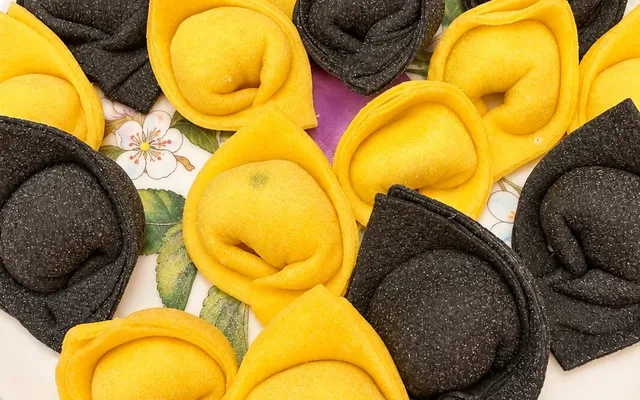
Sea bass cappellacci in a tuxedo
Fish-filled pasta in evening dress
 Ravioli
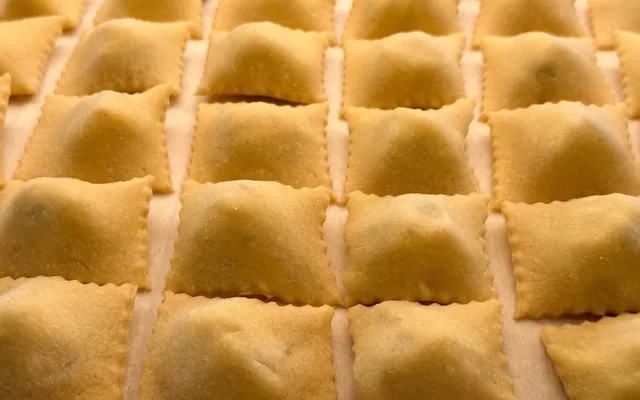
Potato ravioli with porcini mushrooms
Earth and woods: the perfect pairing
 Ravioli
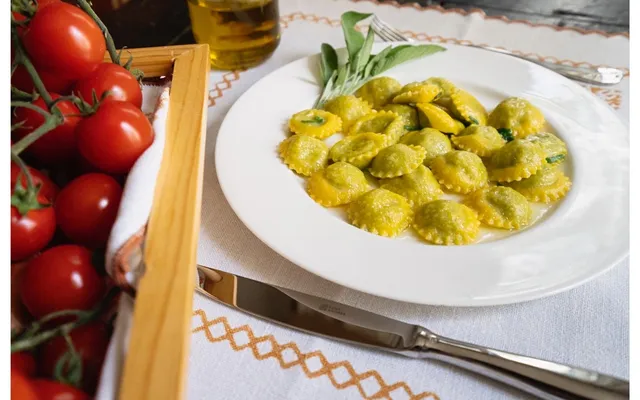
 di ricotta e spinaci
The simplest filling, if the ricotta is the right one